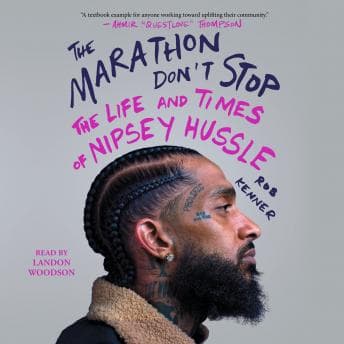

Rob Kenner did his homework. That's the first thing I want to say, because hip-hop biographies can go one of two ways — either the author actually embedded themselves in the community and talked to the people who matter, or they scraped the internet and padded it with cultural commentary nobody asked for. This is the first kind.
I started this one during a rare Sunday meal prep — Carlos had the kids at his mom's house, I had a quiet kitchen and twelve hours to burn through. Didn't finish the chicken adobo until way past dinner because I kept stopping the chopping to just... stand there and listen.
The Crenshaw Kid Who Refused to Leave Crenshaw
What Kenner gets right is the context. He doesn't just tell you Nipsey Hussle was from Slauson and Crenshaw — he walks you through the history of that neighborhood, the Freeway Ricky Ross era, the gang dynamics, the economic devastation that shaped everything. You understand WHY Hussle's decision to stay and invest in his own block was so radical. It wasn't a PR move. It was a strategic, stubborn, sometimes dangerous choice that went against every industry playbook.
As the eldest kid who stayed close to home when everyone told me to aim somewhere else — different circumstances, sure, but I felt that specific brand of stubbornness in my chest. My mom immigrated so we could have options. Nipsey's grandmother did the same from Eritrea. That parallel hit different when Woodson reads those sections about family expectations and cultural identity. The same tug-of-war between where you come from and where you're going runs deep in Open Book.
The book traces Hussle's evolution from the Rollin 60s to the mixtape hustle to Proud 2 Pay to the Grammy-nominated Victory Lap, and Kenner doesn't skip the uncomfortable parts. The street life, the legal troubles, the contradictions of being a gang member who wanted to build a STEM center for neighborhood kids. Kenner holds both truths without trying to smooth them into something neat. Respect for that.
Landon Woodson Carries the Weight — Mostly
Woodson's voice has this steady, warm quality that works for a biography about someone who was known for being measured and intentional. He doesn't try impressions or dramatic voices — he lets the material breathe, and with Kenner's reporting, there's plenty to work with.
One thing I noticed though — and I'm apparently not the only one — there are stretches where it's hard to tell where Kenner's editorial analysis ends and Nipsey's actual perspective begins. Woodson reads both with the same reverence, which blurs the line. Not a dealbreaker, but a few times I rewound trying to figure out who was actually saying what. A slight shift in tone between the journalist voice and the sourced material would've helped.
But when Woodson hits the emotional moments — the final chapters covering the shooting and the aftermath — his delivery is restrained in exactly the right way. No melodrama. Just steady grief. As someone who's actually worked a code and delivered bad news to families at 4 AM, I can tell you: that kind of controlled emotion is harder to pull off than theatrics. He got it right where it counted most.
The Business Chapters Are the Real Gem
Here's what surprised me. I expected to be moved by the personal story — and I was, Carlos asked why I was crying in the car. I blamed allergies. But the sections about Hussle's business philosophy genuinely rewired something in my head. The Proud 2 Pay model — selling a hundred-dollar mixtape and making it work through scarcity and community investment — is the kind of entrepreneurial thinking that deserves a case study. The strip mall investments on Crenshaw, the co-working space concept, his interest in cryptocurrency before most people could define blockchain. That kind of innovative, self-made ethos is exactly the fire Big Magic tries to light under every creator—trust your ideas enough to bet on them.
My mom would love this (she still thinks I should've been a doctor). Not the music sections — she'd probably zone out during those — but the immigrant family hustle, the emphasis on ownership over renting, the generational wealth building. That's her language.
Who Needs This in Their Ears
If you want a standard track-by-track music bio, this will give you some of that, but it's not the point. This is really about community economics. About what happens when someone with vision and street credibility decides to reinvest instead of escape. If you've ever been the person in your family or neighborhood who stays when others leave — you'll feel this one.
Night shift approved, but be warned: it demands your attention. Not background listening. The 12-hour runtime earns its length, but don't speed it up. Woodson's pacing is deliberate and you'll miss context if you rush.
If you have zero interest in hip-hop culture or LA history, you might bounce off the first couple hours. Push through. By hour three it stops being about rap and starts being about something much bigger.
I Sat in My Driveway for Twenty Minutes
Not because I was crying — okay, a little — but because I needed to sit with the unfairness. A man gets shot in front of his own store, in the neighborhood he refused to abandon, by someone from that same community. Kenner doesn't editorialize the tragedy. He just lays it out. And that restraint somehow hits harder than any dramatic retelling could.
Twelve hours well spent. Pass it to someone who needs to hear it.