
"Truth creates money, lies destroy it."
I was about halfway through my morning jog when Suze Orman dropped that line, and I literally stopped on the path to think about it. Not because it's some revolutionary financial insight - it's pretty basic, honestly - but because of what it reveals about how we psychologically sabotage ourselves with money. And that's where this audiobook gets interesting for someone like me.
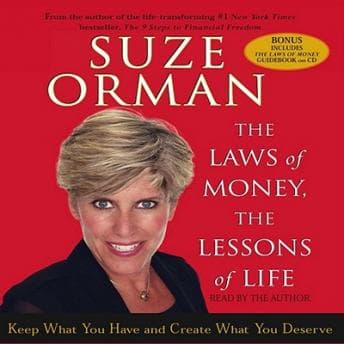
Look, I'm not a finance person. My expertise is in why people do the things they do, especially when those things are clearly against their own interests. So when I picked up Laws of Money, The Lessons of Life, I wasn't looking for stock tips. I wanted to understand Suze Orman's model of financial behavior. And you know what? She actually gets it.
Self-Deception as Financial Strategy (The Bad Kind)
What makes this audiobook compelling from a behavioral standpoint is that Orman isn't really teaching you about money. She's teaching you about self-deception. Law Number Three - "Do What Is Right for You, Before You Do What Is Right for Your Money" - is basically attachment theory applied to personal finance. We make terrible financial decisions because we're trying to meet emotional needs that have nothing to do with our bank accounts.
My therapist would have thoughts about this. (And yes, I did text her a screenshot of my notes.)
Orman's framework is surprisingly sophisticated when you strip away the motivational speaker energy. She understands that financial trouble isn't usually about math - it's about the stories we tell ourselves. The lies we maintain. The research shows that people in denial about their spending aren't stupid; they're protecting their sense of identity. Orman gets this, even if she doesn't cite the academic literature.
The fifth law - "Money Has No Power of Its Own" - is basically a cognitive reframe. She's asking listeners to examine their relationship with money as a psychological construct rather than an external force. That's not nothing.
Your Aunt at Thanksgiving, But Make It Financial Therapy
Author-narrated audiobooks are hit or miss. You know this. I know this. Sometimes brilliant writers have voices that could put a caffeinated squirrel to sleep. But Orman? She's a performer. This is clearly her natural medium.
Her delivery has this urgent, almost confrontational quality that - I'll be honest - can feel like a lot. Like your aunt at Thanksgiving who's had two glasses of wine and really needs you to understand something important. But for this material? It works. She's trying to shake you out of your financial denial, and the intensity serves that purpose.
I found myself asking: why does this directness feel so effective? It's because she's modeling the honesty she's asking from listeners. There's a psychological consistency there. She's not hedging. She's not being polite about it. She's basically saying "your financial life is a mess because you're lying to yourself, and here's how to stop."
Some people will find this grating. Fair. If you need a gentler approach, maybe try something else. But if you respond well to direct confrontation - if you're the kind of person who needs someone to just tell you the truth - this hits different.
The Repetition Problem (Yes, I Sped It Up)
At six hours, this is a reasonable listen. But I'll be real - there's repetition. Orman really wants to make sure you understand each law, which means she circles back. And circles back. By the fourth example illustrating the same point, I was ready to move on.
I listened at 1.25x speed during my second half and that felt right. The pacing improves when you speed it up slightly - her natural pauses become less pronounced and the content flows better. The bonus content at the end provides some additional practical guidance, which is helpful if you're actually trying to implement this stuff rather than just analyzing it like I am.
(Don't tell my students I listen to self-help books for fun. It would ruin my academic credibility.)
Listen If You're Lying to Yourself About Money. Skip If You Just Need a Budget.
If you're looking for detailed investment strategies or specific financial planning advice, this isn't it. Orman is operating at the level of mindset and behavior change. She's essentially doing cognitive behavioral therapy for your wallet.
This is for people who know they're making bad financial decisions and can't seem to stop. People who are in denial about their spending. People who need to understand the why before they can change the what. If that's you, this is genuinely useful. If you've already got your financial psychology sorted and just need tactical advice, skip this and grab something more specific.
I kept thinking about how this compares to Dave Ramsey's approach - which is more prescriptive and rule-based - versus Orman's, which is more about internal transformation. Surrender Experiment takes that internal transformation idea even further - less about controlling outcomes and more about letting go entirely. Different models for different people. Neither is wrong.
Field Notes from a Reluctant Self-Help Consumer
Would I listen again? Probably not - I got what I needed on the first pass. But I'm genuinely glad I listened. It's a fascinating case study in how popular financial advice actually works on a psychological level. And honestly? Some of those laws hit a little too close to home.
My mother would be proud that I'm finally thinking about money. She'd be less proud that I'm analyzing it like a research subject instead of actually balancing my checkbook. C'est la vie académique.