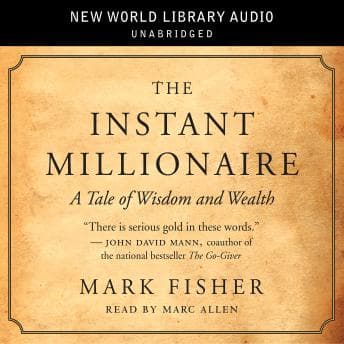

I was debugging a particularly nasty race condition at 11 PM when I realized I needed something short to decompress before bed. Two hours and fourteen minutes? Perfect. I could finish this before midnight and maybe actually sleep.
Here's the thing about business fables—they're either profound in their simplicity or they're blog posts wearing a book costume. The Instant Millionaire lands somewhere in between, and that's both its strength and its limitation.
The Karate Kid Formula for Your Bank Account
Mark Fisher basically wrote a Mr. Miyagi story for wealth-building. Young guy with frustrated dreams meets mysterious wealthy mentor who dispenses wisdom through Socratic dialogue. You've seen this movie. The format works because it's digestible—each lesson builds on the last, and the fictional wrapper makes abstract concepts stick better than bullet points would.
The actual advice? Solid fundamentals. Set specific goals. Write them down. Believe you deserve success before you achieve it. The power of compound thinking. None of this is revolutionary if you've consumed any amount of self-help content, but Fisher presents it with enough clarity that the repetition feels like reinforcement rather than padding.
At 2 hours, the ROI on this audiobook is actually decent. You're not getting 400 pages of anecdotes stretched around three good ideas. It's lean. I finished it in one commute plus my evening routine.
Marc Allen's Voice—A Mixed Bag of Mouth Sounds
Okay, we need to talk about the narration. Marc Allen has this warm, grandfatherly quality that works well for the wise mentor character. When he's in the zone, it genuinely feels like you're getting advice from someone who's been there.
But.
The breathing. The smacking. The swallowing. Once you notice it, you can't un-notice it. There were moments where I was pulled completely out of the lesson because I was suddenly very aware of saliva sounds. It's like when someone on a Zoom call doesn't mute themselves while eating—technically not a dealbreaker, but definitely distracting.
The production quality feels dated, which makes sense for an older recording. No background noise or technical glitches, just... intimate proximity to someone's mouth that I didn't ask for.
Could've Been a Blog Post? Almost, But Not Quite
The fable format saves this from blog-post territory. There's something about following a character through their transformation that makes the lessons land differently than a listicle would. The young man's skepticism mirrors the reader's, and watching him come around gives you permission to do the same.
That said, if you've read Rich Dad Poor Dad, Think and Grow Rich, or any of the classics in this space, you're getting variations on themes you already know. Outliers does something similar—taking familiar success concepts and repackaging them through compelling storytelling. The value here is in the packaging and the brevity, not groundbreaking insights.
One thing I appreciated: Fisher doesn't pretend that mindset alone makes you rich. He acknowledges action, persistence, and specific goal-setting as non-negotiables. 12 Rules for Life takes a similar approach—philosophical framework backed by practical steps you can actually implement. It's not just "manifest your millions" woo-woo. There's practical scaffolding underneath the philosophical stuff.
Who Should Queue This Up (And Who Should Skip)
Perfect for: Someone new to wealth-building concepts who wants an accessible entry point. Also good if you've been in the self-help game a while and need a quick refresher—sometimes hearing the basics in a new voice reactivates something.
Skip if: You've already consumed the major wealth mindset books. You'll spend most of the runtime nodding along to things you already know, and the narrator quirks will annoy you more because you're not learning anything new.
Speed recommendation: 1.5x minimum. The pacing is contemplative (read: slow), and speeding it up actually helps mask some of the mouth sounds. Win-win.
Closing the Terminal
Bottom Line: This is basically The Karate Kid but for your relationship with money. Solid fundamentals, digestible format, questionable audio production. At 2 hours, it's low-commitment enough to be worth trying if you're curious. But if you're already versed in wealth mindset literature, your time is better spent elsewhere.
The narrator situation is genuinely polarizing—some people find Marc Allen soothing, others (like me) got distracted by the ASMR-adjacent mouth sounds. Listen to the sample before committing.
I finished it, I'm glad I did, and I probably won't revisit it. Sometimes that's exactly what you need from a self-help audiobook—a quick hit of perspective without a massive time investment. Just maybe don't listen on nice headphones where you can hear every. single. swallow.