
Thirty-seven minutes. That's it. I finished this during my morning espresso routine—not even a full pour-over cycle. And honestly? That brevity is both the strength and the limitation here.
I found Herendeen's work while scrolling through religion audiobooks at 5 AM, jet-lagged from a client trip to Seoul. Couldn't sleep. My parents' faith—that bedrock Korean Presbyterian conviction—was rattling around in my head. They never read theology books. They just lived it. Fourteen-hour days at the dry cleaners, then church on Sundays without fail. Holiness wasn't a theological question for them. It was the air they breathed.
The 37-Minute Sermon You Didn't Know You Needed
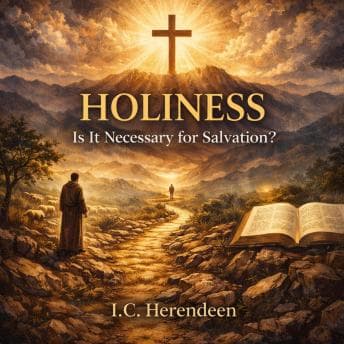
Herendeen, who apparently lived to 99 (1883-1982, if the credits are accurate), doesn't waste your time. The central argument is brutally direct: God demands holiness. Not suggests. Not recommends. Demands. And if you're not pursuing sanctification on earth, don't expect heaven's gates to swing open.
The J.C. Ryle quote that anchors this work—"We must be saints on earth if ever we are to be saints in heaven"—is the kind of theological backbone that modern self-help Christianity tends to avoid. No prosperity gospel here. No "your best life now" padding. Just old-school Reformed conviction delivered without apology.
Here's what works: the argument is coherent and scripturally grounded. Herendeen builds his case methodically, which is impressive given the runtime. He's not trying to be your friend. He's trying to tell you something he believes will determine your eternal destiny. That urgency comes through.
Jason Belvill Does the Job—No More, No Less
Look, I don't have much to work with here. The research turned up basically nothing on Belvill's specific performance, and at 37 minutes, there's not exactly room for dramatic range. What I can tell you: the narration is clean, the pacing is appropriate for theological content, and nothing pulled me out of the material. That's the baseline for religious audiobooks—don't distract from the message.
Is it memorable? No. Is it competent? Yes. For a sub-hour theological treatise, competent is enough.
The ROI Problem
Here's where my consultant brain kicks in. This audiobook costs the same credit as a 15-hour business book or a 40-hour fantasy epic. The content-to-credit ratio is... rough. You're essentially paying premium prices for what amounts to a long podcast episode.
Now, if you're deeply invested in Reformed theology and holiness doctrine, the density of argument might justify it. Herendeen packs genuine theological substance into this runtime. But for the casual listener exploring Christian thought? The value proposition doesn't compute. I had a similar calculation problem with Think and Grow Rich—lots of hype, questionable ROI for the time invested.
My parents would've listened to this, nodded, and said "of course"—then gone back to pressing shirts. They lived this theology without needing it explained. For those of us who grew up watching that kind of faith in action, Herendeen's words feel more like confirmation than revelation.
Who Gets Value Here (And Who Doesn't)
This is for: the Reformed theology enthusiast who wants a focused, no-fluff treatment of holiness doctrine. The believer wrestling with whether sanctification is optional or essential. Someone who has 37 minutes and wants to think seriously about what God actually requires.
Skip it if: you're looking for a comprehensive introduction to Christian theology, you want narrative or personal stories, or you don't already have some theological framework to hang these arguments on.
The Credit Calculation
Bottom line: the content is solid Reformed theology delivered efficiently. Herendeen doesn't pad, doesn't meander, doesn't waste your time. That's refreshing. But—and this is the but that matters—spending a full credit on 37 minutes of audio is hard to justify when the same content could be read in a lunch break.
If this were priced as a short or available through a subscription service, I'd say grab it. As a credit purchase? Wait for a sale or find it through your library's digital collection. The theology is sound. The value math isn't.
Jenny would say I'm being too transactional about matters of eternal destiny. Jenny might have a point. But my parents also taught me not to waste money—and that's a form of stewardship too.