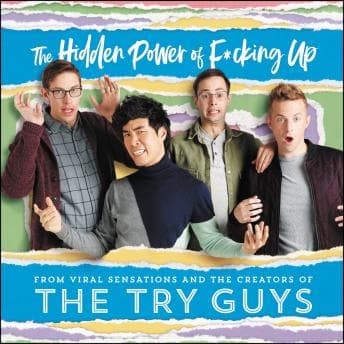

What if the most valuable business lesson isn't in a Harvard case study but in watching four internet comedians repeatedly humiliate themselves on camera?
I know, I know. My parents would be so confused. "You're listening to *what* instead of working?" But here's the thing—I was on a red-eye to Seattle for a client engagement, couldn't sleep, and figured I'd knock out something light. Nine hours later, I'm genuinely wrestling with whether The Try Guys accidentally wrote a better failure framework than half the innovation consultants I've worked with.
The McKinsey Version Would Be 200 Pages Shorter
Let me be direct: this book has maybe 3 hours of genuine insight stretched across nearly 9 hours. At 1.25x speed—which I switched to around hour two—it becomes tolerable. At 1.0x, you'll feel every minute. The pacing is the audiobook equivalent of a meeting that should've been an email.
But here's what saves it: each of the four guys narrates their own chapters, and the authenticity is undeniable. Keith's occasional yelling made me pull out an earbud on the plane (the woman next to me was *not* amused), and Ned gets a bit over-enthusiastic about fatherhood content. But when Eugene gets into his family sections—particularly his attempts to connect with relatives who don't quite understand his path—something shifts. The guy who usually plays the cool, detached one suddenly sounds like every Korean-American kid I grew up with in Koreatown, trying to bridge two worlds that don't always translate.
Zach's chronic illness segments hit different too. There's a vulnerability there that doesn't feel performed. Tina Fey nails this same kind of unfiltered honesty in Bossypants, where the comedy drops just long enough to let you see the actual person underneath. I've seen this in boardrooms when founders finally admit their startup is struggling—that moment when the bravado drops and you get the real person.
What My Parents Did Instinctively. Now It Has a TED Talk.
The core thesis—that failure is the path to growth, that trying things badly is better than not trying at all—isn't revolutionary. My mother and father lived this every day in their dry cleaning business. They failed at things constantly. Wrong suppliers. Bad locations. Customers who never paid. They didn't have a cute acronym for it. They just called it Tuesday.
But here's what the Try Guys add: permission. They give their audience (mostly younger, mostly online) explicit permission to suck at things publicly. And watching them march in heels through LA or simulate labor pains isn't just comedy—it's modeling vulnerability in a way that corporate leadership training programs spend millions trying to replicate.
The "throw caution to the wind" philosophy they preach? I've seen it fail spectacularly at companies that confused recklessness with innovation. But I've also seen the opposite kill more startups—founders so afraid of looking stupid that they never pivot, never iterate, never admit the first idea was wrong.
The Podcast Problem
Here's my issue: some listeners are right that this didn't need to be a book. The format feels like an extended podcast episode, complete with the energy levels that work in 20-minute YouTube videos but exhaust you over 9 hours. The over-acting that's charming on screen becomes grating when you're trying to focus on actual content.
Jenny would say I'm being harsh. Jenny is right.
But I'm also being honest. If you're not already a fan, the inside jokes and references will feel alienating. If you are a fan, you'll probably love hearing their voices walk you through stories you might already know from their videos. It's a weird middle ground—too much personality for newcomers, possibly not enough new material for diehards.
Who Gets Value Here (And Who Doesn't)
This is for the 25-year-old who's paralyzed by perfectionism and needs four goofy dudes to tell them it's okay to try and fail publicly. It's for fans who want the extended director's cut of their favorite internet personalities. It's for anyone who processes self-help better when it comes wrapped in comedy and delivered by people who clearly don't take themselves too seriously.
Skip if you want actionable frameworks. Skip if you're allergic to millennial internet culture. Skip if slow pacing makes you want to throw your phone out the window.
The ROI Breakdown
Bottom line: there's a genuine message here about embracing failure that's worth hearing, delivered by people who actually practice what they preach. The execution is bloated, the pacing needs work, and Keith's yelling nearly cost me a noise complaint at 30,000 feet. But Eugene's family sections alone are worth something. Real emotional honesty from someone clearly still processing his own story.
The core insight is worth the listen. The other 6 hours? Not so much. Speed it up, skip to the personal chapters when each guy gets serious, and you'll find something surprisingly human underneath the internet comedy brand.
Would my parents understand why I spent nine hours on this? Absolutely not. But they'd respect the hustle of four guys who turned "trying stuff and failing" into a career. That's more American Dream than half the business books on my shelf.