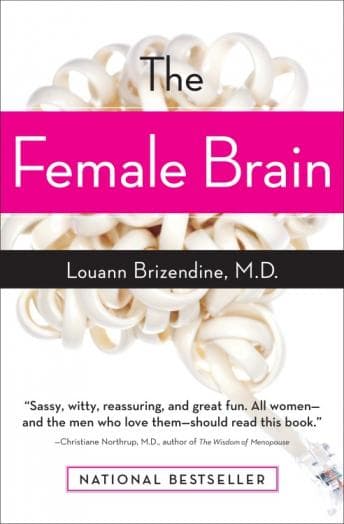

Okay, so I picked this up expecting a straightforward pop-science book about neuroscience. What I got was way more interesting—and occasionally way more frustrating—than I anticipated.
Quick Verdict: Worth your commute if you want accessible neuroscience with some sass, but keep your skeptic hat on.
Here's the thing about The Female Brain: Dr. Brizendine is narrating her own book, and she's clearly passionate about this stuff. You can hear it in her voice. She's not a trained voice actor, but she's got that professor-who-actually-likes-teaching energy that makes 7 hours feel pretty manageable. I finished this in about 4 commutes, which for a science book is solid.
When the Science Gets Spicy
The book throws out some wild claims. Like, the idea that thoughts about sex enter a woman's brain once every couple days versus once a minute for men? I immediately wanted to see the methodology on that study. (Yes, I'm that person.) Brizendine does cite research throughout, but listening to an audiobook means you can't exactly flip to the endnotes and check sources while you're crammed between two guys with backpacks on BART.
What actually works is when she breaks down hormonal cycles and their effects on mood, cognition, and behavior. The sections on puberty, pregnancy brain, and menopause are genuinely useful. I finally have language for why I turn into a different person the week before my period. The ROI on those chapters alone was worth the credit.
But—and this is a significant but—some of the claims feel dated. The book's been around for over a decade now, and neuroscience moves fast. Some of the more essentialist takes on gender differences made me wince. The "every brain starts female" framing is catchy but oversimplified in ways that would make my neuroscience friends twitch.
Brizendine Behind the Mic
Brizendine reading her own work is both a strength and a limitation. Strength: she knows exactly where the emphasis should go, and she's genuinely engaging. She's got this slightly sassy, slightly reassuring tone that works for the material. Limitation: she's not Ray Porter. (But honestly, who is?)
The production is clean—no weird audio artifacts or volume issues that I noticed. At 1.5x speed, her pacing was perfect for my morning commute. I bumped it to 1.75x for some of the more repetitive sections and it held up fine.
What surprised me was how much I didn't hate the author-narrated format here. Usually I'm skeptical when authors read their own nonfiction—they tend to be either monotone or over-caffeinated. Brizendine lands somewhere in the accessible middle. She sounds like a smart friend explaining her research over coffee, not like someone reading a textbook at you.
Where It Drags
Look, some chapters drag. The teen girl section felt like it was written for parents of daughters, and as someone who is neither, I zoned out for chunks of it. The romantic relationship sections are interesting but occasionally veer into "Men Are From Mars" territory that feels a bit reductive.
The best parts are when she's explaining actual neurobiology—how estrogen affects verbal memory, why women tend to read emotional cues faster, the hormonal cocktail of new motherhood. The weakest parts are when she extrapolates from brain differences to sweeping behavioral generalizations.
I kept thinking: this is basically a neuroscience primer for understanding hormonal influences on cognition. Which is genuinely useful! But you have to filter it through a "this was written in 2006" lens.
Who Should Queue This Up (And Who Should Skip)
This is solid commute material. Engaging enough to keep you awake at 6 AM but not so complex that you'll miss crucial points if someone's having a loud phone conversation next to you. (You know the type.)
If you're looking for rigorous, peer-reviewed neuroscience with all the caveats and limitations spelled out—pick up a textbook or some academic papers instead. But if you want an accessible, entertaining overview of how female hormones affect brain function throughout life, with a narrator who clearly loves her subject? This delivers. Skip it if you need cutting-edge research or can't tolerate some dated gender essentialism.
If you're looking for something that tackles relationship dynamics from a completely different angle, Sex: Avoided Subjects Discussed in Plain English takes a more clinical, less neuroscience-heavy approach that some might find refreshing.
Debug Complete
Kevin asked me what I was listening to and I ended up explaining the whole "brain begins as female" thing to him for like 20 minutes. So apparently it's sticky enough to become dinner conversation. Take that as you will.
I finished this in 3 commutes and I don't regret the time. Would I listen again? Probably not. But would I recommend it to someone curious about the topic? Yeah, with the caveat that they should also read some more recent research. The science is a starting point, not the final word.