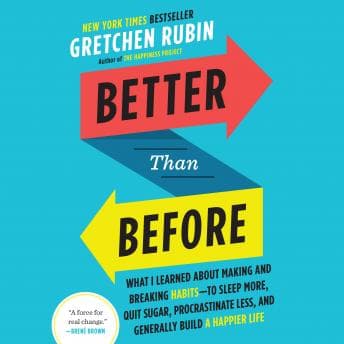

Gretchen Rubin's Four Tendencies framework alone is worth the 9-hour investment. The rest? Let's talk about ROI.
Look, I've read (or listened to, at 2.0x) probably 40 books on habit formation. Atomic Habits, The Power of Habit, that one by BJ Fogg that Jenny bought me for Christmas. Get Sh*t Done was another one that promised the world but delivered mostly repackaged advice. They all blend together after a while—cue, routine, reward, rinse, repeat. So when I started Better Than Before during a particularly soul-crushing commute to a client site in San Jose, I was ready to be disappointed.
I wasn't. Not entirely.
The Framework That Actually Sticks
Here's the thing about Rubin's approach—she doesn't pretend there's one universal system for building habits. The Four Tendencies framework (Upholder, Questioner, Obliger, Rebel) is the kind of insight that sounds obvious after you hear it but isn't. I'm a Questioner, by the way. Shocker. I need to know why before I'll do anything, which explains approximately 80% of the arguments I've had with clients who just want me to "trust the process."
My parents? Classic Obligers. They kept their dry cleaning business running for 25 years because customers depended on them. Not because they loved pressing shirts at 6 AM. Rubin would've understood them better than most business school professors.
The book goes beyond just the tendencies, though. She breaks down strategies—Monitoring, Scheduling, Accountability, the Abstainer vs. Moderator distinction. That last one hit hard. I'm an Abstainer. I can't have "just one" of anything. Potato chips, LinkedIn scrolling, business podcasts. It's all or nothing. Knowing this about myself has saved me from a lot of failed moderation attempts.
Rubin Reading Rubin
She reads her own book, which is always a gamble. Authors aren't actors. But Rubin's conversational tone works here—it genuinely feels like you're getting advice from a very organized friend who's done all the research so you don't have to. There's an ease to her delivery that matches the content.
That said, I get why some people find her style a bit... much. There's a cheerfulness that can feel performative if you're not in the mood. During one particularly rough traffic jam, her upbeat observations about her own habit experiments made me want to throw my phone out the window. (I didn't. That would be an Abstainer move.)
The production is clean. No weird audio issues, no jarring transitions. At 1.5x speed—yes, I dialed it down from my usual 2.0x—she's perfectly intelligible. The bonus podcast episode at the end is a nice touch, though honestly I skipped it. I'd already gotten what I needed.
The Consulting Take
Here's my problem with most habit books: they're written by researchers or journalists who've never had to implement anything at scale. Rubin's different because she uses herself as the test case, which I respect. She's not hiding behind studies. She's saying "I tried this, here's what happened, your mileage may vary."
But—and this is a real but—the book is very Gretchen Rubin. Upper-middle-class New York writer problems. Her examples skew toward things like "maintaining a daily writing practice" and "eating healthier." Nothing wrong with that, but if you're trying to build habits while working three jobs or managing a chronic illness, some of this will feel disconnected from your reality. The framework still applies. The execution examples? Less so.
Who Gets Value Here
If you're struggling to understand why you can't stick to habits that seem to work for everyone else, this is genuinely useful. The self-knowledge angle is underrated in the habit literature. Most books assume you're a blank slate. Rubin assumes you're a specific type of person who needs a specific approach.
For pure tactical advice, Atomic Habits is probably more actionable. But for understanding your own operating system? This one wins.
The self-knowledge angle matters more than people think—even Love Dare, which I read out of morbid curiosity, understood that relationships require understanding how you're wired, not just following a script.
Skip this if: You want step-by-step tactics without the personality framework, or you're already deep in the habit literature and know your tendency type. Listen if: You've tried other systems and they haven't stuck—this might explain why.
The Bottom Line on Your 9 Hours
Skip the first two chapters if you're already familiar with her work. The Four Tendencies quiz is available free online—take it before you start. And if you find yourself getting annoyed by her examples, just translate them into your own context. The principles transfer, even if the specifics don't.
Jenny took the quiz after I finished the book. She's an Upholder. This explains everything about our marriage.