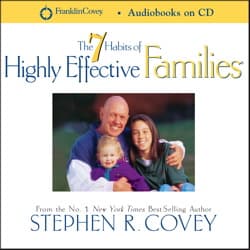

"TRUE HAPPINESS DOES NOT COME FROM POSSESSIONS OR FAME..."
"...it comes from the quality of your relationships with the people you love and respect." Covey says this early on, and I had to pause my treadmill session. (Yes, I listen to management theory while running; it's the only way to multitask the pain.)
Coming from a guy who practically invented the modern corporate productivity lexicon, hearing him pivot to the "soft skills" of family life is jarring. But here's the kicker: he treats the family unit exactly like a struggling startup. And honestly? He's not wrong.
I grew up in a Korean household where the "family mission statement" was implied: Work 14 hours, don't complain, get good grades. Simple. Effective. Brutal. Covey tries to formalize that structure but with way more empathy and fewer dry cleaning chemicals.
THE CEO OF THE DINNER TABLE
If you've read The 7 Habits of Highly Effective People—and if you haven't, are you even in business?—you know the drill. I revisited 7 Habits of Highly Effective People right before this one, and hearing Covey narrate both back-to-back is like getting the full MBA-to-marriage pipeline. Be Proactive. Begin with the End in Mind. Put First Things First. This audiobook is basically that framework, just ported from the boardroom to the living room.
When I listen to modern parenting books, they're usually soft. Lots of "holding space" and vague emotional validation. Covey is different. He's structural. He's talking about "Family Mission Statements" and weekly family meetings.
It sounds rigid—Jenny rolled her eyes when I suggested a Sunday night "Park Family Logistics & KPI Review"—but the logic holds up. I've seen startups fail because the co-founders (parents) weren't aligned on the vision. Covey is basically telling you to get your co-founder alignment sorted before the junior associates (kids) burn the office down.
He narrates it himself. Is he a voice actor? Absolutely not. He sounds like a university professor who's given this lecture ten thousand times. It's dry. It's academic. Zero theatricality. But there's an authority there that a hired actor couldn't replicate. You believe him because he sounds like he's actually lived through the chaos.
ABRIDGED: A FEATURE, NOT A BUG
Here's the thing about this specific version: it's short. Just over 3 hours.
Some reviews complain it lacks depth compared to the full text. They're missing the point. The original 7 Habits is a beast. This is the tactical field manual. At 2.0x speed, I knocked this out in a single gym session and a commute.
For a guy like me, that's perfect. I don't need 15 hours of anecdotes about someone's son mowing the lawn. Get Sh*t Done operates on the same principle—cut the fluff, give me the system. I need the framework.
The "Emotional Bank Account" concept? Gold. It's basically relationship capital. You can't make withdrawals (discipline, asking for favors) if you haven't made deposits (listening, kindness). My parents operated on a deficit model; I'm trying to run a surplus.
WHO'S BUYING, WHO'S PASSING
If you're a systems thinker who wants structure for your home life—not just feelings—this delivers. Parents running on chaos who need a framework, not a hug. Skip it if you want entertainment or can't stomach 90s-era examples; this is a seminar, not a story.
THE BOTTOM LINE (OVER BLACK COFFEE)
If you treat your life—and your family—as the most important project you're managing, this is required reading.
It's dated in spots. The examples feel very 90s. But the physics of human relationships haven't changed.
It's a management consulting deck for your home life. And considering how messy most homes are, we could all use a little McKinsey in the kitchen.