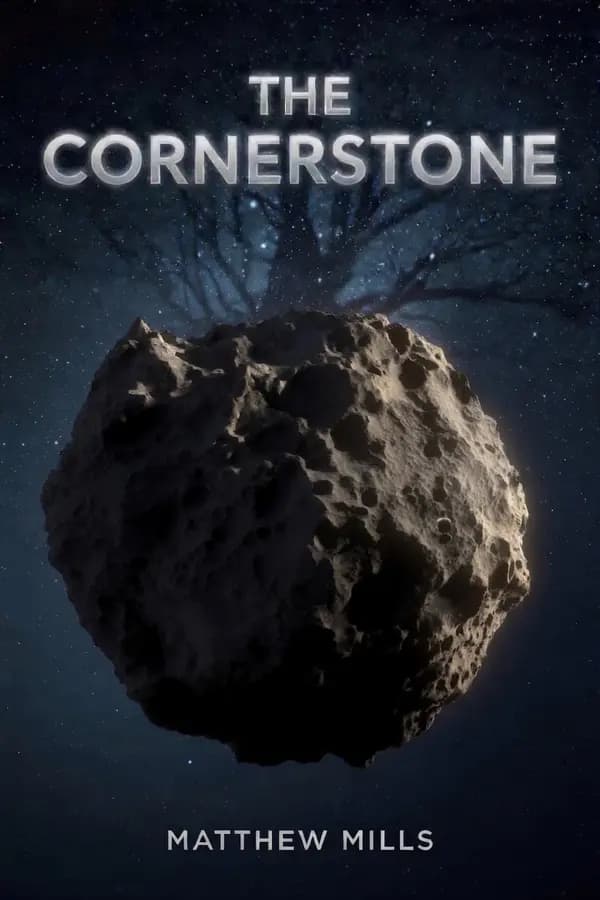
Matthew Mills wrote the novel The Cornerstone with AI assistance on the prose, and the cover art was also made with AI assistance. The audiobook is narrated by Christopher Chamberlain, a human narrator. The author's words below are his own, edited only for format.
By Matthew Mills
I didn't start The Cornerstone with a twist and then invent machines to serve it. I started with hardware you can already trace from today's launch pads: methane rockets, orbital propellant depots, and steel ships you can buy used. Then I let what those machines can and can't do decide what the story was allowed to be. No warp drives. No collapse. In this book, the engineering constraints are the plot.
The Calloways and the Argo
That's the world of The Firmament Line. Jack and Gus Calloway run a family outfit, Calloway Brothers Resource Recovery, out of a used Starship called the Argo. She is an early-production Version 4, bought at a fleet auction with eleven flights in the log, patched plating along the flanks, and a scar on the docking collar. Their ship's intelligence, HARLAN, flies her. Jack supervises and keeps the contracts. Gus is the engineer. The job is a year, door to door: sixty-two days out to a near-Earth asteroid called Vesper-7, eight months on the rock, fifty-one days home.
How a ship slows down
Once you accept that the ship is a freighter and not a magic trick, a lot of the book writes itself. A ship coming home fast has two ways to shed her speed. She can burn propellant against it, a braking burn nearly as expensive as the one that sent her out, or she can skim an atmosphere and pay the bill in heat. The Argo's fourteen-month refit stripped off the old tiled heat shield and put a weeping system under the skin: a lacework of pores that can sweat methane through the steel. A few sacrificed tonnes buy what a braking burn would have charged hundreds for. That is a design choice. It is also a promise the story has to keep.
Life support and the people aboard
The same logic runs the year on site. The Argo carries recyclers sized for a year without resupply. The air was Uncle Ray's line in the sand: full sea-level atmosphere, because a body is built for one particular ocean of air, and a year is too long to live above your depth. In the book, Ray and the boys' father are submariners. I don't pretend the Calloways are my family. I did give them a culture I recognize: months in a sealed hull, a crew that becomes family, and machines you trust with your life because you maintain them yourself.
Budgets and the refinery
Even thinking costs money. Nineteen days into the transit, Jack finds an invoice. Gus has spent eleven thousand dollars of rented constellation compute overnight, running swarm simulations for the anchor drones. The ship's own computers could have done it for free, slowly and crudely. Gus wanted a spiral instead of a grid, better load distribution, maybe an extra half-percent of yield over eight months. The math held. The spiral went down on Vesper-7, and the tugs walked mooring lines up to the Argo's keel. A moored ship spends nothing to stay. Jack, who pays the propellant bill, calls it the cheapest slip in the solar system. That scene exists because a tonne of methane and an hour of compute are both plot.
The mine itself is a closed loop, or as close as physics will allow. Reactor heat bakes water out of clay. Electrolysis splits it into hydrogen and oxygen. A printer turns asteroid nickel-iron into tanks, trusses, and engine bells. A vacuum still uses the fact that, in hard vacuum at white heat, iron and nickel boil away and the platinum-group metals will not. Nothing comes up from Earth to carry the metal back. Gus calls that the most beautiful sentence in engineering: the mine fuels the mine.
The human part of the job
The robots do the digging. The brothers are out there because, millions of kilometers from the nearest repair shop, somebody still has to be present when things break in ways no training data has anticipated. And once you're that far out, a conversation with Earth isn't a conversation. The lag turns every exchange into something closer to letters than to talk. You say your piece. You wait. You learn to say only what you meant.
That is the kind of book The Cornerstone is. The people matter. The family matters. But the story moves when a bill, a burn, a mooring line, or a delay forces a choice that a faster-than-light shortcut would have erased.
The audiobook is narrated by Christopher Chamberlain, a human narrator, and it runs six hours and twenty-four minutes.
Find The Cornerstone
About Matthew Mills
Matthew Mills served as a nuclear-trained submariner in the U.S. Navy. He went on to work in private equity and real estate. He practices Brazilian jiu-jitsu, and he lives with his wife, Robin, and their two sons. The Cornerstone is the first book of The Firmament Line.